How to categorize drawer slides
Leave a message
Here are the 3 main drawer slides, also the advantages and disadvantages.

1. Powder-Coated Slides (Roller Slides)
Powder-coated slides, also known as roller slides, are a simple and economical type of drawer slide. They typically consist of a roller and two rails.
Advantages of Powder-Coated Slides:
- Cost-effective: These slides are budget-friendly and suitable for low-cost furniture.
Disadvantages of Powder-Coated Slides:
- Limited weight capacity: They have a lower weight-bearing capacity compared to other types.
- Lack of cushioning and rebound: Powder-coated slides lack cushioning and rebound features.
- Basic construction: With only two sections, they are considered entry-level in terms of drawer slide options.

2. Ball Bearing Drawer Slides
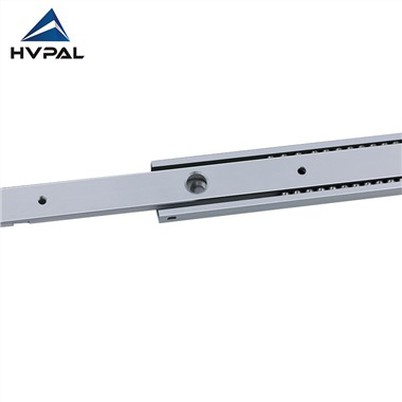
Ball bearing slides use high-precision steel balls as rolling elements within the slides. Typically, a ball bearing slide includes an outer rail with embedded ball bearings to facilitate smooth movement.
Advantages of Ball Bearing Slides:
- Excellent weight-bearing capacity: They can support loads ranging from 10 kg to 500 kg, such as 227 kg heavy duty drawer slides
- Smooth and durable: Thanks to high-quality steel balls, ball bearing drawer slides offer smooth and noise-free operation.
- Full extension: Three-section ball bearing drawer slides allow drawers to fully extend.
- Customizable features: They can incorporate dampening, self-locking, and rebound mechanisms.
Disadvantages of Ball Bearing Slides:
- Market variation: The market is flooded with products of varying quality due to differences in materials used.
- Precise installation required: Proper installation involves ensuring parallel alignment and adjusting the slide's height for smooth operation.
- Side mounting: They are generally side-mounted and do not offer a concealed appearance.
- Professional installation: Installation often requires professional assistance and is not easily removable.

3. Linear Guides
Linear guides, also referred to as linear slides, are used for high-precision, fast linear motion applications, and they can handle some torsional forces as well. They are commonly found in industrial and machine tool applications.
Advantages of Linear Guides:
- High precision: Linear guides offer superior accuracy and stability, making them ideal for precision machining.
- Exceptional rigidity: They are constructed using high-strength materials for excellent rigidity and stability.
- High-speed operation: Linear guides enable high-speed movements and cutting.
- Extended lifespan: Special surface treatments reduce friction and wear, prolonging the life of the equipment.
Disadvantages of Linear Guides:
- Vulnerable to external forces: Linear guides are susceptible to external forces like gravity and lateral pressure, potentially leading to deformation or wear.
Specialized applications: They are primarily used in specialized, high-precision machinery and may not be suitable for general furniture.
In conclusion, the choice of drawer slides depends on the specific requirements of your furniture or application. Powder-coated slides are economical but have limitations in weight capacity and functionality. Ball bearing slides offer a balance of cost and performance but require precise installation. Linear guides excel in precision and high-speed applications but are not suitable for all uses. Understanding these differences can help you select the most appropriate drawer slide for your needs, ensuring smooth and efficient operation of your furniture or equipment.